Saturday, June 18, 2022

Permaculture Design Course, Darjeeling, India


Permaculture Design Course

5 November to 20 November 2022

Mineral Springs, Darjeeling

Permaculture Design Course fees, inclusive of training material, food and lodge:

International Candidates Rs. 60,000:00

Indian Nationals residing outside Darjeeling but working in India Rs. 45,000:00

Discounts available for Darjeeling Hills’ residents. Please contact for details

Training venue “Mineral Springs, Dabaipani, Darjeeling”

Mineral Springs, Dabaipani is an internationally certified organic and fair-trade labeled collective of 456 small farmers since 2002. The farmers have come under the Mineral Spring Sanjukta Vikas Sanstha since 1996. The collective has been marketing small farmers' organic tea in the international market. The tea is grown as part of a polyculture crop, within thousands of acres of Forest Garden and food systems

The participants will have home stay accommodations facilities with the members of Mineral Spring Sanjukta Vikas Sanstha.

Teacher: Rico Zook ( www.i-permaculture.org )

Co-Teachers: Reed.Burnam (Insta: @r33d_b) Guest Teachers: Sailesh Sharma , Siddarth Blone

Host: DLR Prerna. www.darjeelingprerna.org FB: Darjeeling Prerna

For further details

Darjeeling Ladenla Road Prerna

c/o Hayden Hall Complex,

42 Ladenla Road,

Darjeeling 734 101,

West Bengal, India.

Phone Number: +91 9800869959 (Sailesh Sharma)

darjeelingprerna@gmail.com saileshkharel@gmail.com rairoshan@gmail.com

A working knowledge of English is required by the participant. We do not look for academic qualifications for the course, except an interest to be part of a sustainable lifestyle and be the change you want to see in the world.

NB: **** DLR Prerna and Rico reserves the right to admit candidates to the course. Candidates will be notified of their participation on receipt of the completely filled application form.

Permaculture Design Course Description

Permaculture is a design system to create regenerative, sustainable systems. Envisioned over 25 years ago by Bill Mollison and Dan Holmgren, from Australia, it has now spread to over 120 countries. Though its conception was as a land-based system, its effectiveness has moved it into urban settings and to being applied in various social, political, and economic environments.

Permaculture was created through the synthesis of many design systems, with the emphasis on nature as the penultimate one. Similarly, the insights and value of traditional and indigenous practices and knowledge are acknowledged along with the necessity of molding these with our current understandings and the appropriate technologies of today's world. What Permaculture seeks to do is to create three-dimensional designs that are site specific and sustainable. By bringing together elements (orchard, water system, farmer, cow, etc.), techniques (organic farming, natural building, etc.) and strategies (microclimate, relative placement, etc.) a system is designed or altered based on regenerative relationships. It is these regenerative, beneficial relationships that give a system complexity, three dimensionality, and thus, resiliency.

The world can be looked at as the convergence of many different flows. From ‘natural’ (wind, water, soil, etc.) to human (social, resources, transportation, etc.) to invisible (economic, information, etc.) which interact and create patterns. These flows form our world. Recognizing this, Permaculture teaches Pattern Literacy and Pattern Application. This, along with Sector Analysis (site specific flow mapping), Zonation (a tool for structuring time) and other techniques and tools, Permaculture focuses on creating regenerative relationships that are the key to resilient, sustainable systems.

From its inception Permaculture has quickly spread to over One hundred and twenty countries where farms and other sites are successfully applying its' ideas, techniques and strategies. As further testament to its applicability, Permaculture is now being applied in many urban and suburban areas. In many developed countries these applications hold much promise for dealing with the many issues associated with mass populations.

Permaculture in the last few years has been moving into the invisible structures. In the United States a Permaculture credit union has been formed and 'green' investment firms are using Permaculture principles and ideas to create resilient, sustainable investment systems. Environmentalists and social activists are using Permaculture to give depth and complexity to their approaches to many issues we are dealing with today. These applications are possible because Permaculture is a design system that focuses on relationship and not so much on object.

Permaculture is a multi-faceted, in-depth design system that will help us create appropriate, site-specific designs that are both sustainable and regenerative.

Permaculture principles are a list of attitudes, approaches, and actions that are practical and not system specific. These along with certain tools and techniques allow for a holistic approach and interaction with any type of system. As a tool of analysis,it is an excellent way to look at existing programs, strategies, and interventions to assess their interactions, linkages, and success'. It is a way to reach an understanding of the various influences and flows involved in a system, be it self-help groups, village, or organization. Second, it provides insights and principles by which to intervene or interact with a system. As there is neither a truly independent system, nor sterile 'environment' this aspect is of significant importance. Thirdly, as we have already stated, Permaculture is an excellent approach for designing resilient, site-specific systems, be it disaster preparedness, HIV/AIDS, or women's empowerment.

It is important to understand that Permaculture is not so much about giving you new and improved ideas, techniques, and strategies, though there is some of that. What Permaculture does is allow for a deeper understanding of the situation at hand and, with its principles and strategies, a more holistic, effective way to interact with or design a system.  What Permaculture offers are skills and principles by which we build our awareness of why or why not something was successful. Through this insight we can build on what is successful and modify others to become more successful.

Stepping up another level, Permaculture is an excellent way to weave together the different parts of an organization so that a unity and synergy can be created. In this way unforeseen benefits and ease will emerge within the system. As a real-life experience this course is structured permaculturally, modeled as a regenerative invisible structure, thus creating deeper and synergistic learning

This workshop will present Permaculture with all of these applications in mind. We will focus on land systems with as much hands-on work and examples as possible. In addition, many discussions and examples will be explored of possible applications in what are called the 'Invisible Structures', the social, cultural, political, and economic structures that shape much of our world today.

Subjects will include:

        Permaculture Ethics and Principles

        Pattern Literacy and Application (physical and invisible)

        Energy and Resource Management  

        Site Assessment,Sector Analysis and Zonation

        Water; Harvesting, Holding, and Recycling

        Soil, its health, building and restoration 

       Plants, Cropping, and Seed Saving

       Animal Systems

        Farm as Ecosystem

        Appropriate Technologies

        Climatic Strategies and Micro-climates

        Climate Change and Design for Catastrophe

        Natural Building, siting and orientation

        The Design Process

        Social Permaculture

        Urban Permaculture

        Permaculture in the Developing Countries

        Permaculture and Organizations

AND MORE!

This workshop will culminate with several groups doing real-life design projects that will be relevant to the site of the workshop.

This workshop will contribute to the enrichment of its site and each of its participants. With the goal of having half international students and half local students this workshop will not only be an opportunity to learn about Permaculture, it will also offer an opportunity to understand we can create a regenerative, sustainable world together.

The person attending the Permaculture Design Course will not only gain theoretical and practical knowledge on Permaculture at the end of the workshop but will be handed a Permaculture Design Course Certificate. This certificate will enable the participant to be a certified Permaculture Practitioner.

Richard Rico Zook

Permaculture Designer, Consultant and Educator

www.i-permaculture.org 

Rico brings over four decades of experience in nature to his work. As well as creating and working with a wide variety of land-based systems in all types of climatic environments, for the past 24 years he has been a Permaculture designer, consultant and educator working with farmers, villagers, private individuals, and local organizations in India, Cambodia, Spain, USA, the mid-east and other parts of the world. This work focuses on assisting all levels of our global community to create culturally and environmentally appropriate life systems that are resilient and regenerative.

With a degree in Environmental Studies focused on Land Restoration, minors in biology and philosophy, with years of homesteading in northern California and working in Yosemite Nat’l Park, Rico came to permaculture with almost all the elements, but no organizing structure or system. From 1996 to 2005 he was first co-director and crew foreman for the land restoration crew, then land manager at a wilderness community decimated by wildfire in the mountain wilderness of northern New Mexico. Guided and mentored by Ben Haggard (https://regenesisgroup.com/team), for ten years Rico did hands-on permaculture design and installation rebuilding a community and village from the ground up.

Over the years he has worked from the village level to the international. For the International Permaculture Convergence in India he organized, managed and taught the pre convergence PDC, with Robyn Francis and an Int’l instructor crew of of Jude Hobbs, Starhawk, Govinda Sharma and others; and the Teacher Training, with Jude Hobbs(https://cascadiapermaculture.com/).  Currently, when not developing his farm in Hawaii,  much of his work is assisting and mentoring his advanced students who are now working in permaculture and evolving as instructors. 

For more information about Rico and his work go to www.i-permaculture.org

Darjeeling Ladenla Road Prerna (DLR Prerna) www.darjeelingprerna.org FB: Darjeeling Prerna

DLR Prerna is a Darjeeling based NGO working in the Darjeeling Hills since 1996.

Vision Statement

Darjeeling Ladenla Road Prerna believes in a world that sees the need to live as one family where the environment is preserved and protected, where conscious efforts are made to remove unjust structures while striving to build a just and humane society.

Mission statement 

Our mission is to build sustainable human communities in the Darjeeling hills and the adjoining areas by promoting people's participation, gender equality and living in harmony with the environment. 

Darjeeling Prerna works towards having regenerative relationships with small farmers, forest villagers, tea plantations workers, CBOs, CSOs, Educational Institutions and NGOs in furthering the vision and mission of the organisation. We are a Darjeeling based organisation and our interventions are grounded in the specificities and long term lived experiences within the Darjeeling Himalaya. Our relationships extend across Sikkim as part of the Darjeeling Sikkim Himalaya. We bring these experiences to the larger discussion tables negotiating invisible systems that needs supportive policy environments. Darjeeling Prerna believes in a participatory, inclusive and environment friendly approach to development and is the organisational philosophy of good governance within and in all our interventions.

Current focal areas:

1.  Community conservation

We work with communities living next to forests especially protected areas in Darjeeling and Sikkim focussing on sustainable agro-ecology, and managing mountain human wildlife conflict and advocating for mountain human wildlife conflict policies. Agro-biodiversity conservation is an integral part of the intervention.

2. Climate resilient communities

We work with small farmers in Darjeeling and Sikkim evolving and promoting climate smart agriculture and agro-forestry. Promotion of diversity of local food cultures is a critical aspect of our climate resilience intervention and nutrition sensitive agro-ecology.

3. Community Health

We work with tea plantation workers, small farmers and educational institutions especially in rural Darjeeling.

a.    Water and Sanitation: Knowledge, institution and infrastructure strengthening to access clean and safe water for all. We are piloting bio-digesters; evapo-transpiration systems, grey water management systems as well as springshed recharge as part of our work. We promote sustainable menstrual health and hygiene. 

b.    School Health:

                      i.      Preventive health education inclusion in curriculum, screening and referrals in partnership with rural primary schools.

                    ii.        TeaLeaF: Teacher leading frontline addressing mental health and promoting mental wellbeing of rural children.

4. Zero Waste

We promote zero waste principles and practices as a member of Zero Waste Himalaya. We facilitate direct interventions in Darjeeling and Sikkim with local self-governance institutions, community-based institutions, government institutions and educational institutions. We share need for a change in narrative of waste to not producing waste, no-burn, demanding systemic and design changes across the Indian Himalayan Region through the Integrated Mountain Initiative. Zero Waste discussions include changing food choices and the need to go local and unpackaged.

5. Knowledge

Contextualised sustainability knowledge and practise within the Darjeeling and Sikkim Himalaya that is evolved in partnership with small farmers, forest villagers, plantation workers and educational institutions.

Permaculture: DLR Prerna’s philosophy and practice has evolved with permaculture principles and ethics and is woven in our invisible and visible interventions. We have beenoffering the Permaculture Design Courses in the Darjeeling Hills with Rico Zook as the trainer since 2005. Shorter term courses for farmers, community leaders and teachers are being facilitated by the DLR Prerna team in the local language.

6. Platforms, Networks and Partnerships

We believe that our effectiveness, reach and impacts are made manifold through Platforms, Networks and Partnerships. Our intervention experiences are transferred to policy landscapes as well as bring solidarity across the Indian Himalayan Region through the Integrated Mountain Initiative a platform of elected, bureaucrats and civil societies advocating for mountain sensitive policies. Our waste interventions are taken forward under the Zero Waste Himalaya, a pan Himalayan platform of individuals and organisations promoting principles of zero waste.

** IMPORTANT NOTE **

Full Fee deposit is required to secure your spot in this course. Registration without deposit will only hold a spot in the course until we are filled. If you have not deposited the fee by this time your spot will be given to someone who does make the deposit.

International Candidates please contact Darjeeling Prerna for details.

CANCELLATION POLICY

This course is offered at the lowest possible pricing to make it accessible to as many people as possible. As such a late cancellation can have a significant impact on our budget. For this reason we have the following cancellation policy.

6 weeks or more notice: full refund minus 5% processing fee

4 to 6 weeks notice: refund minus 25%

2 to 4 weeks notice: refund minus 50%

2 weeks or less notice: refund minus 75%

KINDLY NOTE THAT WE WILL BE FLEXIBLE WITH THE COVID19 SITUATION.

WE WILL FOLLOW COVID19 SAFETY PROTOCOLS

CANCELLATION IF NEEDED DUE TO COVID19 WILL BE CONSIDERED AND THE CANCELLATION POLICY WILL NOT BE APPLICABLE THEN AND WILL WORK ON FULL REFUND


Thursday, April 8, 2021

Permaculture Design Course Nov 2021, Darjeeling India

Permaculture Design Course

13 November to 28 November 2021

Mineral Springs, Darjeeling

Permaculture Design Course fees, inclusive of training material, food and lodge:

International Candidates Rs. 47,000

Indian Nationals residing outside Darjeeling but working in India Rs. 37,000

Discounts available for Darjeeling Hills’ residents. Please contact for details

Training venue “Mineral Springs, Dabaipani, Darjeeling”

Mineral Springs, Dabaipani is an internationally certified organic and fair-trade labeled collective of 456 small farmers since 2002. The farmers have come under the Mineral Spring Sanjukta Vikas Sanstha since 1996. The collective has been marketing small farmers organic tea in the international market, which is grown as a polyculture crop.

The participants will have home stay accommodations facilities with the members of Mineral Spring Sanjukta Vikas Sanstha.

Teacher: Rico Zook ( www.i-permaculture.org )

Co-Teachers: Reed.Burnam, Jyoti Deshpande, Malvikka Solanki, Sailesh Sharma

Host: DLR Prerna. www.darjeelingprerna.org FB: Darjeeling Prerna

For further details

Darjeeling Ladenla Road Prerna, c/o Hayden Hall Complex, 42 Ladenla Road, Darjeeling 734 101, West Bengal, India.

Phone Number: +91 9800869959 (Sailesh Sharma)

darjeelingprerna@gmail.com saileshkharel@gmail.com rairoshan@gmail.com

A working knowledge of English is required by the participant. We do not look for academic qualifications for the course, except an interest to be part of a sustainable lifestyle and be the change you want to see in the world.

NB: **** DLR Prerna and Rico reserves the right to admit candidates to the course. Candidates will be notified of their participation on receipt of the completely filled application form.

Permaculture Design Course Description

Permaculture is a design system to create regenerative, sustainable systems. Envisioned over 25 years ago by Bill Mollison and Dan Holmgren, from Australia, it has now spread to over 120 countries. Though its conception was as a land based system, its effectiveness has moved it into urban settings and to being applied in various social, political, and economic environments.

Permaculture was created through the synthesis of many design systems, with the emphasis on nature as the penultimate one. Similarly, the insights and value of traditional and indigenous practices and knowledge are acknowledged along with the necessity of molding these with our current understandings and the appropriate technologies of today's world. What Permaculture seeks to do is to create three-dimensional designs that are site specific and sustainable. By bringing together elements (orchard, water system, farmer, cow, etc.), techniques (organic framing, natural building, etc.) and strategies (microclimate, relative placement, etc.) a system is designed or altered based on regenerative relationships. It is these regenerative, beneficial relationships that give a system complexity, three dimensionality, and thus, resiliency.

The world can be looked at as the convergence of many different flows. From ‘natural’ (wind, water, soil, etc.) to human (social, resources, transportation, etc.) to invisible (economic, information, etc.) which interact and create patterns. These flows form our world. Recognizing this, Permaculture teaches Pattern Literacy and Pattern Application. This, along with Sector Analysis (site specific flow mapping), Zonation (a tool for structuring time) and other techniques and tools, Permaculture focuses on creating regenerative relationships that are the key to resilient, sustainable systems.

From its inception Permaculture has quickly spread to over One hundred and twenty countries where farms and other sites are successfully applying its' ideas, techniques and strategies. As further testament to its applicability, Permaculture is now being applied in many urban and suburban areas. In many developed countries these applications hold much promise for dealing with the many issues associated with mass populations.

Permaculture in the last few years has been moving into the invisible structures. In the United States a Permaculture credit union has been formed and 'green' investment firms are using Permaculture principles and ideas to create resilient, sustainable investment systems. Environmentalists and social activists are using Permaculture to give depth and complexity to their approaches to many issues we are dealing with today. These applications are possible because Permaculture is a design system that focuses on relationship and not so much on object.

Permaculture is a multi-faceted, in depth design system that will help us create appropriate, site-specific designs that are both sustainable and regenerative.

Permaculture principles are a list of attitudes, approaches, and actions that are practical and not system specific. These along with certain tools and techniques allow for a holistic approach and interaction with any type of system. As a tool of analysis it is an excellent way to look at existing programs, strategies, and interventions to assess their interactions, linkages, and success'. It is a way to reach an understanding of the various influences and flows involved in a system, be it self help groups, village, or organization. Second, it provides insights and principles by which to intervene or interact with a system. As there is neither a truly independent system, nor sterile 'environment' this aspect is of significant importance. Thirdly, as we have already stated, Permaculture is an excellent approach for designing resilient, site-specific systems, be it disaster preparedness, HIV/AIDS, or women's empowerment.

It is important to understand that Permaculture is not so much about giving you new and improved ideas, techniques, and strategies, though there is some of that. What Permaculture does is allow for a deeper understanding of the situation at hand and, with its principles and strategies, a more holistic, effective way to interact with or design a system.  What Permaculture offers are skills and principles by which we build our awareness of why or why not something was successful. Through this insight we can build on what is successful and modify others to become more successful.

Stepping up another level, Permaculture is an excellent way to weave together the different parts of an organization so that a unity and synergy can be created. In this way unforeseen benefits and ease will raise within the system.

This workshop will present Permaculture with all of these applications in mind. We will focus on land systems with as much hands on work and examples as possible. In addition, many discussions and examples will be explored of possible applications in what are called the 'Invisible Structures', the social, cultural, political, and economic structures that shape much of our world today.

Subjects will include:

  • Permaculture Ethics and Principles
  • Pattern Literacy and Application (physical and invisible)
  • Energy and Flows          
  • Sector Analysis and Zonation
  • Water; Harvesting, Holding, and Recycling
  • Soil, Plants, and Environments
  • Agriculture; From Your Doorstep to the World
  • Buildings
  • The Design Process
  • Urban Permaculture
  • Permaculture in the Developing Countries
  • Permaculture and Organizations

This workshop will culminate with several groups doing a real life design projects that will be relevant to the site of the workshop. Not only will the teaching be about Permaculture, but it will also model it by its structure and the environment we create together in the course.

This workshop will contribute to the enrichment of its site and each of its participants. With the goal of having half international students and half local students this workshop will not only be an opportunity to learn about Permaculture, it will also offer an opportunity to understand we can create a regenerative, sustainable world together.

The person attending the Permaculture Design Course will not only gain theoretical and practical knowledge on Permaculture at the end of the workshop but will be handed a Permaculture Design Course Certificate. This certificate will enable the participant to be a certified Permaculture Practitioner.

Richard: Rico Zook

Permaculture Designer, Consultant and Educator www.i-permaculture.org 

Rico brings over four decades of experience in nature to his work. As well as creating and working with a wide variety of land-based systems in all types of climatic environments, for the past 22 years he has been a Permaculture designer, consultant and educator working with farmers, villagers, private individuals, and local organizations in northern India, Cambodia, Spain, USA, the mid-east and other parts of the world. This work focuses on assisting all levels of our global community to create culturally and environmentally appropriate life systems that are resilient and regenerative.

With a degree in Environmental Studies focused on Land Restoration, minors in biology and philosophy, with years of homesteading in northern California and working in Yosemite Nat’l Park, Rico came to permaculture with almost all the elements, but no organizing structure or system. From 1996 to 2005 he was first co-director and crew foreman for the land restoration crew, then land manager at a wilderness community decimated by wildfire in the mountain wilderness of northern New Mexico. Guided and mentored by Ben Haggard (https://regenesisgroup.com/team), for ten years Rico did hands-on permaculture design and installation rebuilding a community and village from the ground up.

Over the years he has worked from the village level to the international. For the International Permaculture Convergence in India he organized, managed and taught the pre convergence PDC, with Robyn Francis and an Int’l instructor crew of of Jude Hobbs, Starhawk, Govinda Sharma and others; and Teacher Training, with Jude Hobbs (https://cascadiapermaculture.com/).  Currently much of his work is assisting and mentoring his advanced students who are now working in permaculture and evolving as instructors. 

For more information about Rico and his work go to www.i-permaculture.org

Host:  

Darjeeling Ladenla Road Prerna (DLR Prerna) www.darjeelingprerna.org FB: Darjeeling Prerna

DLR Prerna is a Darjeeling based NGO working in the Darjeeling Hills since 1996.

Vision Statement

Darjeeling Ladenla Road Prerna believes in a world that sees the need to live as one family where the environment is preserved and protected, where conscious efforts are made to remove unjust structures while striving to build a just and humane society.

Mission statement 

Our mission is to build sustainable human communities in the Darjeeling hills and the adjoining areas by promoting people's participation, gender equality and living in harmony with the environment. 

Darjeeling Prerna works towards having regenerative relationships with small farmers, forest villagers, tea plantations workers, CBOs, CSOs, Educational Institutions and NGOs in furthering the vision and mission of the organisation. We are a Darjeeling based organisation and our interventions are grounded in the specificities and long term lived experiences within the Darjeeling Himalaya. Our relationships extend across Sikkim as part of the Darjeeling Sikkim Himalaya. We bring these experiences to the larger discussion tables negotiating invisible systems that needs supportive policy environments. Darjeeling Prerna believes in a participatory, inclusive and environment friendly approach to development and is the organisational philosophy of good governance within and in all our interventions.

Current focal areas:

1.  Community conservation

We work with communities living next to forests especially protected areas in Darjeeling and Sikkim focussing on sustainable agro-ecology, and managing mountain human wildlife conflict and advocating for mountain human wildlife conflict policies. Agro-biodiversity conservation is an integral part of the intervention.

2. Climate resilient communities

We work with small farmers in Darjeeling and Sikkim evolving and promoting climate smart agriculture and agro-forestry. Promotion of diversity of local food cultures is a critical aspect of our climate resilience intervention and nutrition sensitive agro-ecology.

3. Community Health

We work with tea plantation workers, small farmers and educational institutions  especially in rural Darjeeling.

a.    Water and Sanitation: Knowledge, institution and infrastructure strengthening to access clean and safe water for all. We are piloting bio-digesters; evapo-transpiration systems, grey water management systems as well as springshed recharge as part of our work. We promote sustainable menstrual health and hygiene. 

b.    School Health:

                      i.      Preventive health education inclusion in curriculum, screening and referrals in partnership with rural primary schools.

                    ii.        TeaLeaF: Teacher leading frontline addressing mental health and promoting mental wellbeing of rural children.

4. Zero Waste

We promote zero waste principles and practices as a member of Zero Waste Himalaya. We facilitate direct interventions in Darjeeling and Sikkim with local self governance institutions, community based institutions, government institutions and educational institutions. We share need for a change in narrative of waste to not producing waste, no-burn, demanding systemic and design changes across the Indian Himalayan Region through the Integrated Mountain Initiative. Zero Waste discussions include changing food choices and the need to go local and unpackaged.

5. Knowledge

Contextualised sustainability knowledge and practise within the Darjeeling and Sikkim Himalaya that is evolved in partnership with small farmers, forest villagers, plantation workers and educational institutions.

Permaculture: DLR Prerna’s philosophy and practice has evolved with permaculture principles and ethics and is woven in our invisible and visible interventions. We have been offering the Permaculture Design Courses in the Darjeeling Hills Rico Zook as the trainer since 2005. Shorter term courses for farmers, community leaders and teachers are being facilitated by the DLR Prerna team in the local language.

6. Platforms, Networks and Partnerships

We believe that our effectiveness, reach and impacts are made manifold through Platforms, Networks and Partnerships. Our intervention experiences are transferred to policy landscapes as well as bring solidarity across the Indian Himalayan Region through the Integrated Mountain Initiative a platform of elected, bureaucrats and civil societies advocating for mountain sensitive policies. Our waste interventions are taken forward under the Zero Waste Himalaya, a pan Himalayan platform of individuals and organisations promoting principles of zero waste.

** IMPORTANT NOTE **

Full Fee deposit is required to secure your spot in this course. Registration without deposit will only hold a spot in the course until we are filled. If you have not deposited the fee by this time your spot will be given to someone who does make the deposit.

International Candidates please contact Darjeeling Prerna for details.

CANCELLATION POLICY

This course is offered at the lowest possible pricing to make it accessible to as many people as possible. As such a late cancellation can have a significant impact on our budget. For this reason we have the following cancellation policy.

6 weeks or more notice: full refund minus 5% processing fee

4 to 6 weeks notice: refund minus 25%

2 to 4 weeks notice: refund minus 50%

2 weeks or less notice: refund minus 75%


Saturday, January 23, 2021

“Ensuring students social-emotional wellbeing during the COVID-19” OR “Rebuilding Wholesome Classroom Communities”


Webinar on “Ensuring students social-emotional wellbeing during the COVID-19” OR “Rebuilding Wholesome Classroom Communities”

Click here for: WEBINAR REGISTRATION LINK: 

Date: 29th January 2021

Time: 10:00 AM-12:00 PM OR 4:00 PM-6:00 PM

Language: English/Hindi

Duration: 2 hours

Learning Outcomes

At the end of the webinar session, attendees will be able to:


  1. Describe the importance and role of the educational ecosystems in supporting the health and mental wellbeing of students during (and beyond) the Covid-19 pandemic.
  2. Understand that a safe return to school during the Covid-19 involves more than just policies to reduce the risk of virus transmission but also as a process of rebuilding classroom/school community and supporting the mental wellbeing of students.
  3. Think creatively about solutions that can be adopted and adapted within their own institutions.

Agenda:

1. Welcome and Overview   

2. Lessons learnt during the COVID19 lockdown – Teachers, Students, Parents

3. Key stakeholders presentation

4. DLR Prerna’s presentation on COVID19 safety in the school ecosystem

5. QnA

Background

COVID-19 pandemic has dramatically changed how we live our lives. The pandemic and lockdown has thrown challenges that we have had to negotiate with no previous experience. We are figuring out the 'new normal' with COVID19.

The impact of the Covid-19 pandemic is particularly significant within the context of the education sector. There is an urgent need to analyse and create interventions pathways of what exactly is the ‘new normal’ in the education sector.

As schools reopen amidst an ongoing pandemic, it is crucial to implement good health and hygiene practices. As the pandemic is expected to persist for a significant period of time, the school health environment must be adapted to ensure safety and wellbeing. Furthermore, it is crucial that schools incorporate lessons on health and hygiene into the daily curriculum in order to promote public health both within the school building and broader community. These efforts to promote and protect student health and wellbeing must be sustained during and beyond the Covid-19 pandemic.

A safe return to school during pandemic involves more than just policies and practices to reduce the risk of virus transmission. Already there are reports of increased stress and anxiety among teachers, children and parents which needs to be addressed with new skills and insights. With limited access to mental health care common in the education sector of India, Covid-19 has enhanced the need to incorporate mental health care and access at a policy and institutional level.

In this webinar, we propose to explore issues of physical and mental health in educational institutions during the context of the Covid-19 pandemic with key stakeholder representatives presenting their insights and perspectives. We anticipate a robust conversation that will inform the policy landscape of the educational ecosystem. Additionally, we will identify concrete practices, policies, and practices that attendees may adapt and adopt into their own institutions.

To enhance this discussion, DLR Prerna and Broadleaf will present an intervention package that has been developed with our rural school partners in the Darjeeling Himalayas to address the challenges of promoting student health and wellbeing during the Covid-19 pandemic. We will discuss and share our curriculum and training programmes with webinar attendees. Additionally, we will highlight opportunities to engage in partnership with our team to conduct a four days training for school communities in other regions of India.

Friday, September 25, 2020

DLR Prerna & Broadleaf is hiring - Project Officer, Education


Job Title: Project Officer – EDUCATION - CHHIP 

Location: Darjeeling, West Bengal India 

Organisation: DLR Prerna and Broadleaf 

Job Description 

DLR Prerna Broadleaf partner with children and families in the Eastern Himalaya to develop innovative school-based health programs that improve educational outcomes and maximize well-being. We believe a holistic, community-based approach to improving education and wellbeing can unlock human potential and create opportunities for every child to thrive. We intend to hire a project officer to support the implementation of our school health program (CHHIP) in rural primary schools of the Darjeeling Himalayas. This position will have a specific focus on the education components of this program and providing broad support to education initiatives across our organization. 

What we are looking for? 

We are seeking a talented and skilled professional to join our dynamic team. We envision this as a long-term relationship and are particularly interested in early career professionals with the desire to learn and grow with us. While prior teaching experience is not required, an interest in education is a must. We are especially interested in candidates who will use this position to learn about innovative, forward-thinking models of education and grow into a leader in the education-space in Darjeeling. 

Qualifications 

• BA/S or equivalent is preferred but not required. Advanced degree, certification, or training in Education, Child Development, Social Work or other relevant field is preferred. 
• Prior education or experience is desirable but not required. 
• Ability to work independently and take initiative. 
Must be a quick learner, able to multitask, and self-manage 
• Desire to grow and develop as a professional 
• Excellent written and verbal communication skills. 
Must be fluent in spoken Nepali. Language skills in spoken English and written English and/or Nepali preferred. 

We strongly encourage individuals, including classroom teachers, affiliated with our existing community projects to apply. 

Reports Directly to Project Director - DLRPrerna Broadleaf 

Directly Supports School health workers Partner Communities (school administration, teachers, staff, parents and caregivers, and students) 

How to apply: 

Please send us your resume along with a statement about why you are excited to join our team and why you are the right fit. You may send this to dlrpbroadleaf@gmail.com 

No other forms of application will be entertained. 

If we are interested, your submission will be responded to within 14 days. 

Please note that due to a large volume of application, your application may not be responded to. 

DLR Prerna reserves the right to all decisions.

Wednesday, April 15, 2020

Situation Report on COVID-19 and Lockdown Impact in Rural Areas of Darjeeling District 13 April 2020

Summary and Recommendations:


DLR Prerna circulated a Rapid Response Survey to our community partners in rural Darjeeling District.  Our Survey was designed to get a basic understanding of the different ways in which the COVID-19 Pandemic and the current lockdown were having an impact on rural communities.  A significant portion  of our work takes place in rural schools, so we asked some specific questions about education arrangements. 

The 158 respondents include Primary School Teachers in Low-Cost Private Schools (27%), Tea Plantation Workers (27%), Students (10%), Community Health and Social Workers (10%), Skilled and Semi-skilled workers (7%),  Farmers (5%) Unemployed Community Members (13%). 

The survey format (Google Forms in Nepali and English) was only accessible to people with internet access, appropriate technology (smart phone or computer) and who are literate. We also conducted more in-depth telephone interviews with selected community representatives.

The three biggest concerns for all respondents were Food (57 %), Gas/LPG (36%), Family Health (22%). 
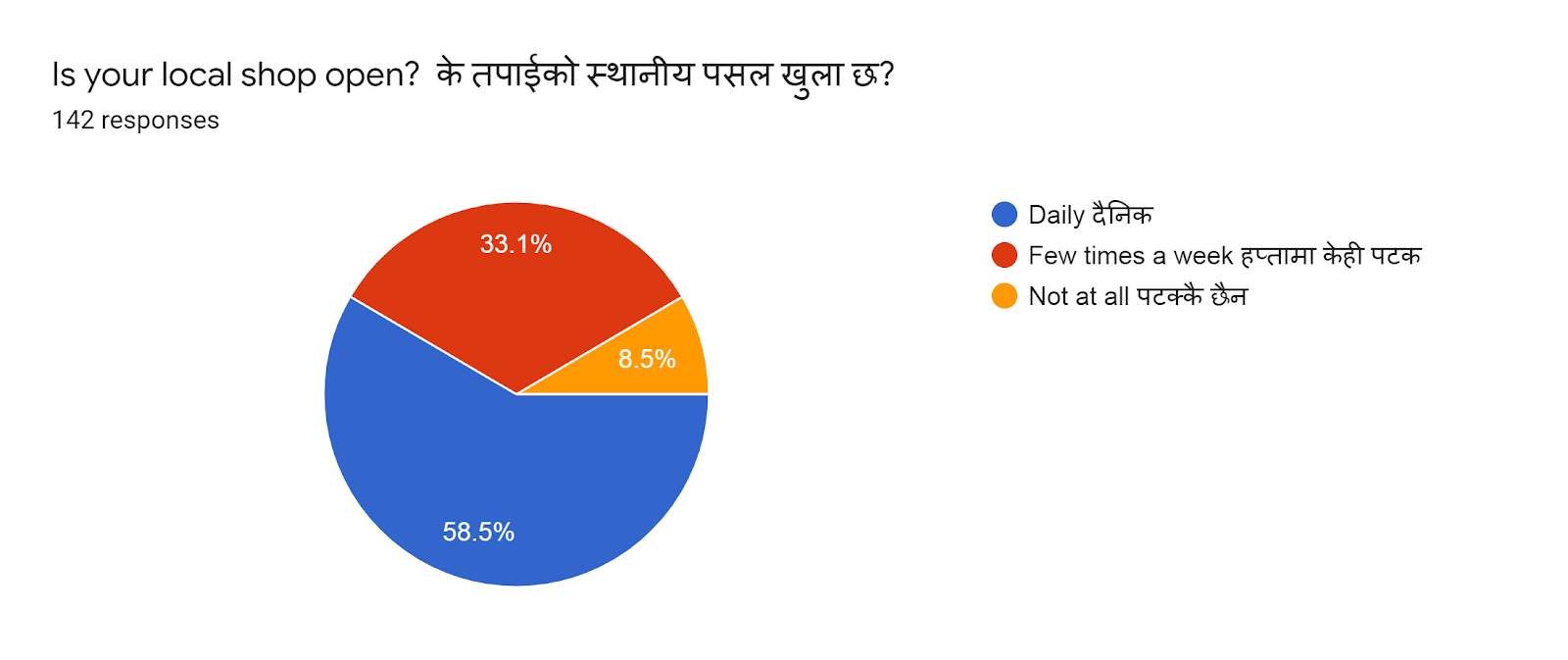
  • In some rural areas, shops are not opening at all. It is unclear if this is due to lack of stock, due to fear on the part of the shopkeepers, or some other reason. It is essential that people have access to essential goods as close to home as possible.
  • While most people have now received free rations from PDS, they have concerns about securing dahl, oil and vegetables.
  • Communities are also concerned because many people can not get necessary medicines, masks and sanitizers, cleaning products
  • Given that LPG is exempt from current restrictions, it must be examined if there are issues in supply chains to rural areas.
  • More than 50% of those who sell vegetables and milk are no longer selling their produce. Of those who usually sell, livestock, meat and poultry, none are currently selling. Food supply should be maintained and producers can maintain their income.
  • 74 % of respondents said that some families in their community need immediate extra help with food, money and medicine.

Rural areas have been very proactive and local Samaj, local police and community members have been working hard to ensure community compliance with social distancing and lockdown measures. However, in some villages, this means that no-one can come in and out, posing a difficulty for access to essential goods and services. 

In many communities, the vehicle owners and drivers are no longer coming to town. While all travel must be reduced, this must also be balanced with the need to maintain supply chains for essential items like food, LPG and medicines. Some farmers and producers have also been unable to send their produce to market, resulting in financial losses. Some awareness and support is needed to ensure that the supply chain can be maintained safely. 

People are very concerned about wage loss. In some areas, people received only pay for 9 out of 15 days in the last pay period.


Children and Education:
About three quarters of teachers were able to send work home to the children, and about the same proportion are in touch with parents/guardians during the lockdown. Most teachers are using Whatsapp groups to send work and remain in touch with children and their families. However, not everyone has access to communication facilities. Some teachers are sending work to neighbours of children who then share it with the family. 

Parents are concerned as many children are struggling with their studies within the COVID19 lockdown. We must identify:
  • if the type and difficulty of work being set for students is appropriate
  • if the amount of work being set for students is appropriate
  • what supports students needs
  • what support do parents need to guide their children.

Major challenges identified for children (by parents, family members and caregivers - we did not ask children directly) included difficulties in completing studies, loneliness and boredom, having to stay indoors, lack of space/support in the house to study/play.

Challenges identified for children by their teachers included:
Parents are struggling to guide the children in completing any study or work
  • The need for some kind of structured learning
  • Support for students who do not have access to whatsapp or other online messaging platforms
  • Need for games, play and enjoyment
  • Some children do not have access to their school books, educational materials, pencils
  • Need for accurate health information and awareness, as well as good nutrition
We must identify ways to reach out and support parents and children, especially those who are marginalised and may not have access to technology and support.


More Details: Situation Report on COVID-19 and Lockdown Impact in Rural Areas


Darjeeling Prerna circulated a Rapid Response Survey to our community partners in rural Darjeeling in a google survey format in Nepali and English. The first survey was sent on 1 April 2020. In addition to basic details on the respondents, the survey asked about their current concerns, about their access to essential food and medicines, about financial implications, and about the impact on children and their education.

The three biggest concerns for all respondents were Food (57 %), Gas (36%) and Family Health (22%). However, among non-teachers, 70% reported that food access was a major concern. Respondents were from 16 tea plantations, 3 forest villages and 9 different khasmal villages and towns.

It is important to note that many respondents are concerned about access to Gas(LPG). Given that this is exempt from current restrictions, we are not sure if there are issues with supply chains to rural areas. 

Access to Food:
Forms response chart. Question title: Is your local shop open?  के तपाईको स्थानीय पसल खुला छ? . Number of responses: 142 responses.
While it is clear that many shops have reduced their opening times, it is concerning that for some respondents, their local shop is not open at all. It is unclear if this is due to lack of stock, due to fear on the part of the shopkeepers, or some other reason. It is essential that people have access to essential goods as close to home as possible. 

Even in rural areas, only one third of respondents are growing any kind of food. Of those who are growing, maximum (82%) are only growing for home consumption which is an encouraging step towards food security. Although the sample size is small, more than 50% of those who sell vegetables and milk are no longer selling their produce. Of those who usually sell, livestock, meat and poultry, none are currently selling.

This needs further investigation to ensure food supply is maintained and that producers can maintain their income. 

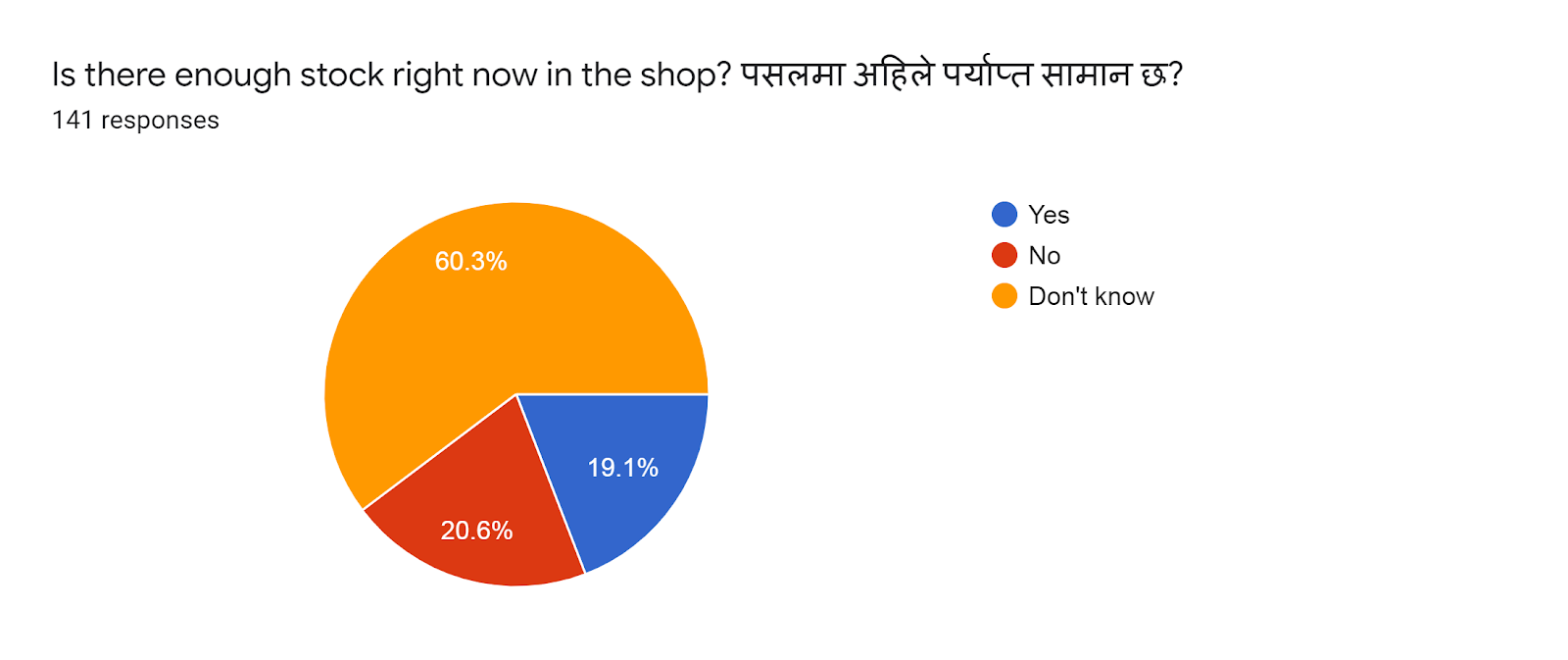
When asked if stock levels in their local shops were sufficient, respondents were unsure.
We must ensure sufficient food stock as close to community as possible. 
Forms response chart. Question title: Is there enough stock right now in the shop? पसलमा अहिले पर्याप्त सामान छ?  . Number of responses: 141 responses.

74 % of respondents said that some families in their community need immediate extra help with these items. Even with the distribution of sufficient food under the PDS, food distribution must be considered from the perspective of nutritional security of rural communities by ensuring diversity of food distribution to include pulses and other key nutritious food. 

Questions about Children and Education: For parents who were surveyed, we asked if they had received schoolwork from their child’s school:

40% of parents reported that children are not managing to complete studies and work sent by the school. This needs further exploration to understand the challenges and find out:
  • if the type and difficulty of work being set for students is appropriate
  • if the amount of work being set for students is appropriate
  • what supports students needs
  • how can we support parents to guide the children

Major challenges identified for children (by parents, family members and caregivers - we did not ask children directly) included:
  • Difficulties in completing studies
  • Loneliness and boredom, having to stay indoors
  • Lack of space/support in the house to study/play
Challenges identified for children by their teachers included:
  • Parents are struggling to guide the children in completing study or work
  • The need for some kind of structured learning
  • Solutions for students with no whatsapp or online access
  • Need for games, play and enjoyment
  • Some children need their school books, educational materials, pencils
  • Need for accurate health information and awareness, as well as good nutrition

About three quarters of teachers were able to send work home to the children, and about the same proportion are in touch with parents/guardians during the lockdown.  

We must identify ways to reach out and support parents and children, especially those who are marginalised and may not have access to technology and support. Key messages must include:
  • Acknowledgment of stress and anxiety
  • Mental health supports for parents and children
  • Key public health messages for parents and children
  • Practical ways to support teachers and parents


PDC November 2025

  Permaculture Design Course 1st November to 16th November 2025 Mineral Springs, Darjeeling   Permaculture Design Course  fees, inclusive of...